
Read Brown County Property Tax Records
Brown County tax records are a linked set, not one sheet. The Assessor keeps parcel data and gross assessed value. The Auditor handles deductions. The Treasurer bills, collects, and runs the tax sale. Reading each field beside its keeper keeps a payment question from being mistaken for a valuation question.
| Field | What It Shows | Where |
|---|---|---|
| Land and improvement values | The components and gross total used for taxation | Assessor property card and DLGF search |
| Deductions | Homestead, mortgage, Over 65, veteran, disability, and other approved reductions | Brown County Auditor |
| Tax bill and payment | Amount billed and collection status | Brown County Treasurer and InvoiceCloud |
| Assessment and bill year | The value year and the following year's tax bill | DLGF assessment data and bill |
| Sale evidence | Sale date, price, class, township, and neighborhood used in analysis | Assessor, sales disclosures, and ratio study |
Indiana's standard is market value-in-use. That is the value for the property's current use, and it is not automatically the most recent sale price. The tax bill is not a resale statement either. Deductions, rates, and other tax rules shape it. For a fuller explanation of those value terms, use the Brown County property value guide.
Three Brown County Tax Offices, Three Jobs
The Brown County Assessor is Mari H. Miller. The office sits at 201 Locust Lane. It maintains real and personal property assessments, sales information from 2007 forward, appeals, and neighborhood analysis. Homestead, mortgage, Over 65, veteran, and disability deduction questions are expressly routed to the Auditor rather than treated as valuation matters.
Assessor
Values parcels, maintains property cards and sales data, and receives the first assessment appeal. Phone: 812-988-5466.
Auditor
Administers deductions, tax accounting, and transfer-related materials. Phone: 812-988-5485.
Treasurer
Collects property taxes, links online payment, and administers tax-sale work. Phone: 812-988-5458.
All three offices share the same county building. A precise request still saves time, though. Ask the Assessor about square footage or value, the Auditor about a deduction, and the Treasurer about a payment or delinquency.
Note: Office hours published for the Assessor are Monday through Friday, 8:00 a.m. to 4:00 p.m.
Search Brown Assessments Through Indiana DLGF
The DLGF assessed-value search accepts assessor data from Brown County. It returns results as downloadable Excel files. Exact text is not always the best key. DLGF suggests trying part of a street name or part of a last name when a full query misses. County formats vary. Keep leading zeroes intact when moving between the state site and the Brown County WTH GIS. Keep punctuation intact too.
| Search clue | How to use it | What to verify |
|---|---|---|
| Street name | Try a partial street name before adding every address element | Property address and county |
| Owner surname | Use part of the last name if spelling or co-owner text differs | Owner and mailing address |
| Parcel number | Copy the complete identifier from WTH | Full suffix and leading zeroes |
| Assessment year | Select the value year, then connect it to the next bill year | Total land and improvements |
The field labeled Assessed Value Total Land and Improvements equals the gross assessed value on the notice or bill. Read it beside the parcel identity and year. It is not a free-standing price estimate. The official search instructions appear in this DLGF assessed-value source.
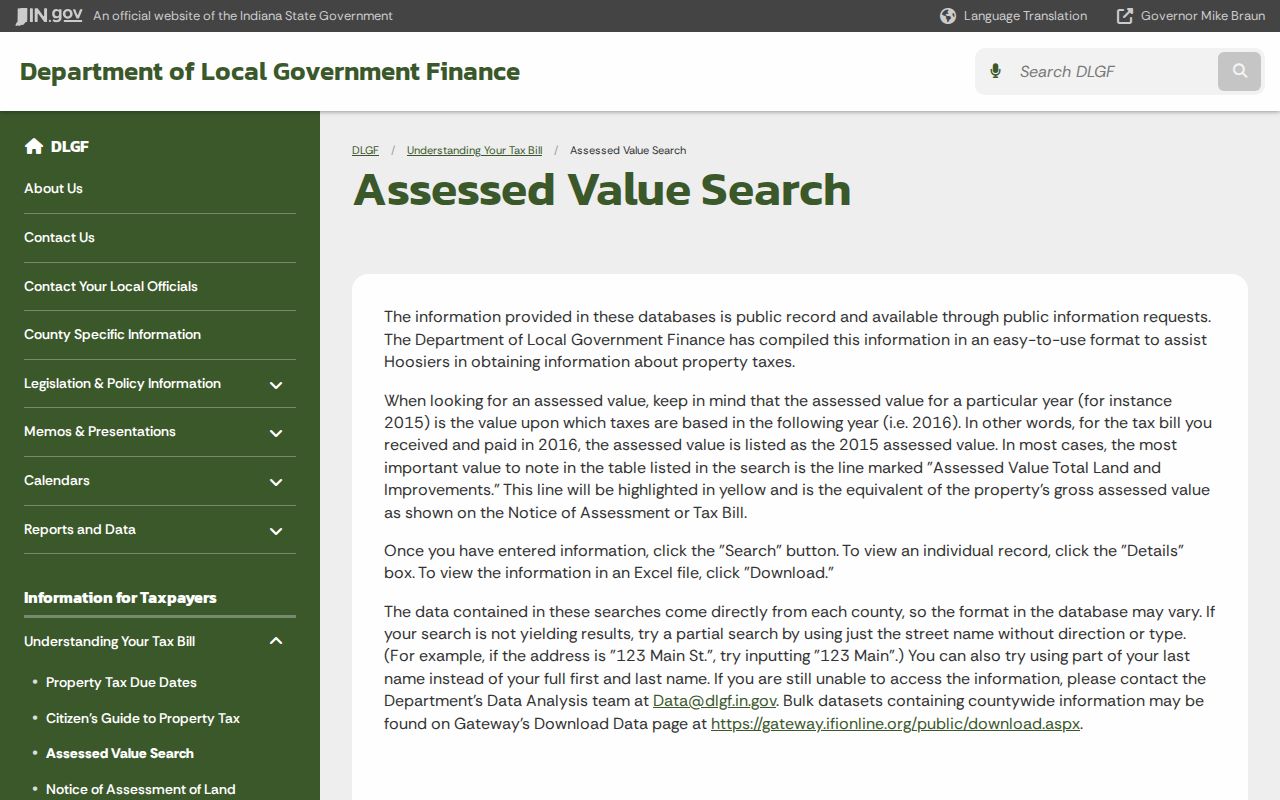
The DLGF page routes readers to statewide value data. Brown County remains the source for parcel-specific corrections, so fix errors at the county office that keeps the record.
Look Up a Brown County Tax Bill
Identify the parcel before opening the bill. Use WTH when an address is the only clue. Then the Treasurer's county page offers the InvoiceCloud payment route or the state past-bill service. The bill year is not the assessment year. Keeping those years straight matters when you compare a Brown County property tax lookup against assessment records.
- Locate the parcel by address in Brown County WTH GIS and copy both the county and state parcel numbers.
- Open the Treasurer's page and follow its payment link, or use DLGF's past-tax-bill search.
- Match the owner, parcel, bill year, and status before relying on an amount.
- Check deduction questions with the Auditor and valuation questions with the Assessor.
- Assessed value
- The Assessor's value for tax administration, before the bill calculation.
- Levy or rate
- The tax component applied under the relevant taxing units and rules.
- Homestead deduction
- A principal-residence deduction administered by the Auditor when eligibility and filing rules are met.
- Tax lien
- A public claim tied to unpaid property taxes, distinct from the assessment itself.
A portal failure is not the end of access. Call or visit the Treasurer about bills and collection status, the Auditor about deductions, or the Assessor about value and card data. Written requests also work. A precise letter can proceed under the Indiana Access to Public Records Act, IC 5-14-3.
Brown County Deductions Belong With the Auditor
Deductions can change the tax bill without changing the Assessor's view of the parcel. Brown County routes deduction filings to the Auditor. They cover homestead, mortgage, Over 65, veteran, and disability deductions. The homestead form asks for the owner's identity, address, parcel or legal-description details, and principal-residence status. It also requires a signature and related certifications.
Indiana's homestead rules cite IC 6-1.1-12-37, with a supplemental deduction under IC 6-1.1-12-37.5. County material states that an owner who becomes ineligible must report the change. The window is 60 days. Improper deductions can be recaptured with a 10 percent civil penalty, so an old deduction should never be assumed to survive a transfer or a change in use.
Note: A missing deduction is not the same issue as an incorrect land or improvement value.
Brown County Ratio Studies and the 2026 Cycle
DLGF defines the assessment ratio as assessed value divided by sale price. Indiana's target is 100 percent. The median level for a class and township should fall roughly between 90 and 110 percent. Brown County's reports split the analysis among Hamblen, Jackson, Van Buren, and Washington townships and property classes. One sale is one observation. It does not automatically reset every nearby parcel.
The next statewide cyclical reassessment begins July 1, 2026. It covers the 2026 pay-2027 cycle, with about 25 percent of parcels in each jurisdiction re-inspected each of four years. Inspectors may review construction, garages, pools, and other physical characteristics, so a card change can reflect the inspection schedule. The DLGF ratio-study explanation lays out the method.
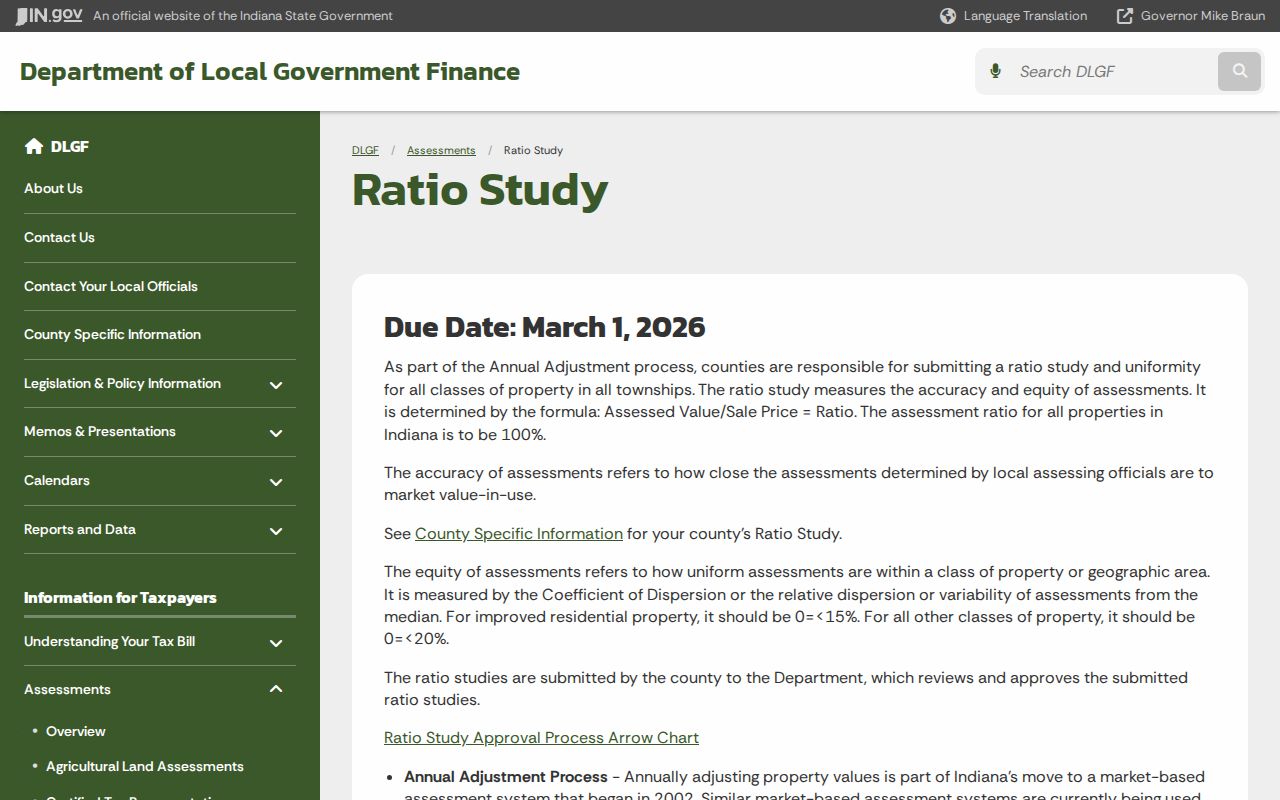
Sale price and assessment can differ while both figures stand correct.
Delinquent Brown County Property Tax and Sales
A late Brown County tax bill shifts the search toward tax-sale administration. The move takes you past ordinary collection records. The Treasurer links to GUTS tax-sale information covering tax-sale dates, advertising lists, and bidder procedures. Sold items and status materials appear there too. Owner names and mailing details may change. Check those lists by parcel number instead.
Tax-sale status is not the same as a court foreclosure. Mortgage foreclosure and quiet-title cases live in the Brown Circuit Court file and Indiana MyCase. County tax delinquency and tax sale begin with the Treasurer instead. Anyone researching a distressed parcel should compare the tax record, Recorder instruments, and the court docket. No single list stands in for a complete title report.
Contest a Brown County Property Tax Assessment
Brown County mails Form 11 each year. If it is mailed by May 1, the filing window runs through June 15 of that same assessment year. When no Form 11 arrives, the tax bill itself serves as notice. An initial appeal uses Form 130. It is filed separately for each parcel with the Assessor. The Assessor should respond within 90 days. Form 130 asks for the owner or petitioner, contact and mailing details, the county, property address, parcel number, year, current assessment, classification, requested correction, reason, signature, any representative, and a list of evidence. Good evidence might be the subject sale, comparable sales, offers, an appraisal, or income and expense figures. An appraisal is not required. If nothing gets resolved, the case can move to PTABOA. The next step is the Indiana Board of Tax Review on Form 131. The final stop is Tax Court. Objective errors include the wrong person listed. They also cover a deduction or credit problem, a clerical or math mistake, a property description issue, or a legal question. Some objective claims reach back three years, with Form 17T used for refund requests.
Appeal window. File Form 130 by June 15 when Form 11 was mailed on or before May 1, and use one form for each parcel.
The county's assessment appeal instructions appear in the following capture.
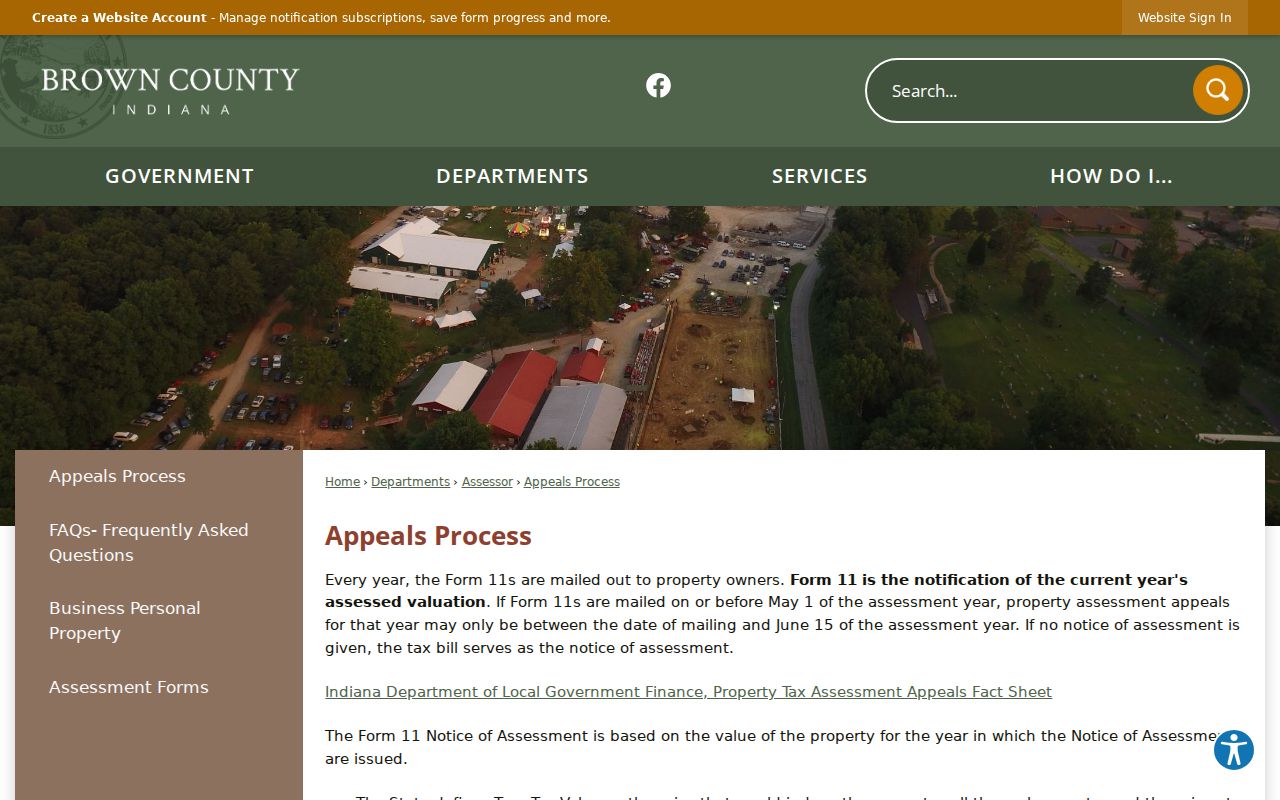
Check the county page first for the appeal filing deadline.