
Three Brown County Value Numbers
Brown County value research usually comes down to three numbers. One is the administrative assessment. Another is Indiana's market value-in-use standard, and the third is the consideration or sale price attached to a recorded transfer.
| Value | What It Is | Where |
|---|---|---|
| Assessed value | Gross value assigned to land and improvements for the assessment system | WTH card, Assessor, DLGF search |
| Market value-in-use | Indiana's willing-buyer and seller value for continued current use | DLGF assessment guidance |
| Recorded sale price | Consideration reported for a particular transfer, when public and available | Sales disclosure, sales fields, deed context |
| Land and improvements | The components that add to total assessed value | Property card and ratio-study rows |
A sale can carry family terms, bundled parcels, or odd financing. Condition and exemptions shape a price too. One deal does not reset every Brown County assessment, and assessed value is no forecast of what a buyer will pay.
Brown Assessment Card Values
The Brown County WTH GIS portal ties a parcel to its property card. Per the Assessor, that card shows the assessed value and the property data behind it. That data runs long. Year built and story count can appear. So can exterior type and outside-measured square footage. Plumbing fixtures, garages, and pools may show up. Central air, fireplaces, finished spaces, and porches also appear.
Check the assessment year first. Brown County bases current-tax-year assessed value on January 1 of the prior year. DLGF adds a caution. Assessment year corresponds to the following tax-bill year. This page stops at valuation meaning. Bill amounts, deductions, and appeals belong with Brown County property tax records.
Indiana Market Value-in-Use
Indiana DLGF defines market value-in-use as the value of property for continued current use, set within a willing-buyer and willing-seller frame. It is an assessment standard. It is not a promise that a Brown County property value equals the most recent deal on the street.
The Brown County Assessor draws on sales information to establish neighborhood base market rates, then adjusts for location, distance to amenities, and other influence factors. No single price gets copied onto a card. Mass assessment applies common methods across many parcels. An appraisal works differently. A licensed appraisal analyzes one specified property and an effective date for a particular assignment.
- Assessed value
- The gross land and improvement value reported in the assessment system.
- Market value-in-use
- Indiana's value concept for property in its current use.
- Assessment ratio
- Assessed value divided by sale price for ratio-study analysis.
- Consideration
- The value stated or reported for a transfer, subject to its actual terms.
- Reassessment
- The statutory process of reviewing property data and values over a cycle.
Look Up Brown County Value
Hold the parcel number and year constant while moving between county and state records. Values lose meaning without those labels.
- Search WTH by address, owner, or parcel number and open the matching Card. For vacant land, use the APN because no residence address may exist.
- Record the assessment year and the land, improvement, and total assessed value. Also note the physical facts supporting the card.
- Check the DLGF assessed-value search. Try a partial street or owner name if an exact query fails.
- Use the Gateway sales-disclosure search and recorded deed context for a sale price, then compare its date and parcel scope.
The DLGF search exports results to Excel. Formats vary by county. Brown County Assessor staff can clarify a card by phone at 812-988-5466, by email at assessor@browncounty-in.gov, by mail at PO Box 351, or in person at 201 Locust Lane, Nashville.
Brown's Ratio Study Context
DLGF defines the assessment ratio simply. It is assessed value divided by sale price. Indiana's target level is 100 percent, and Brown County's 2026 ratio study reports sale date, study sale price, current land assessed value, improvement assessed value, total assessed value, AV/SP, and variation.
The study sorts data by township. Hamblen, Jackson, Van Buren, and Washington townships all appear, along with property classes that include improved and vacant residential samples. DLGF expects a median level within roughly 90 to 110 percent at the class or township level. That test measures group equity. It does not force each parcel's assessed value to match its last price.
The official DLGF ratio-study page explains the comparison:
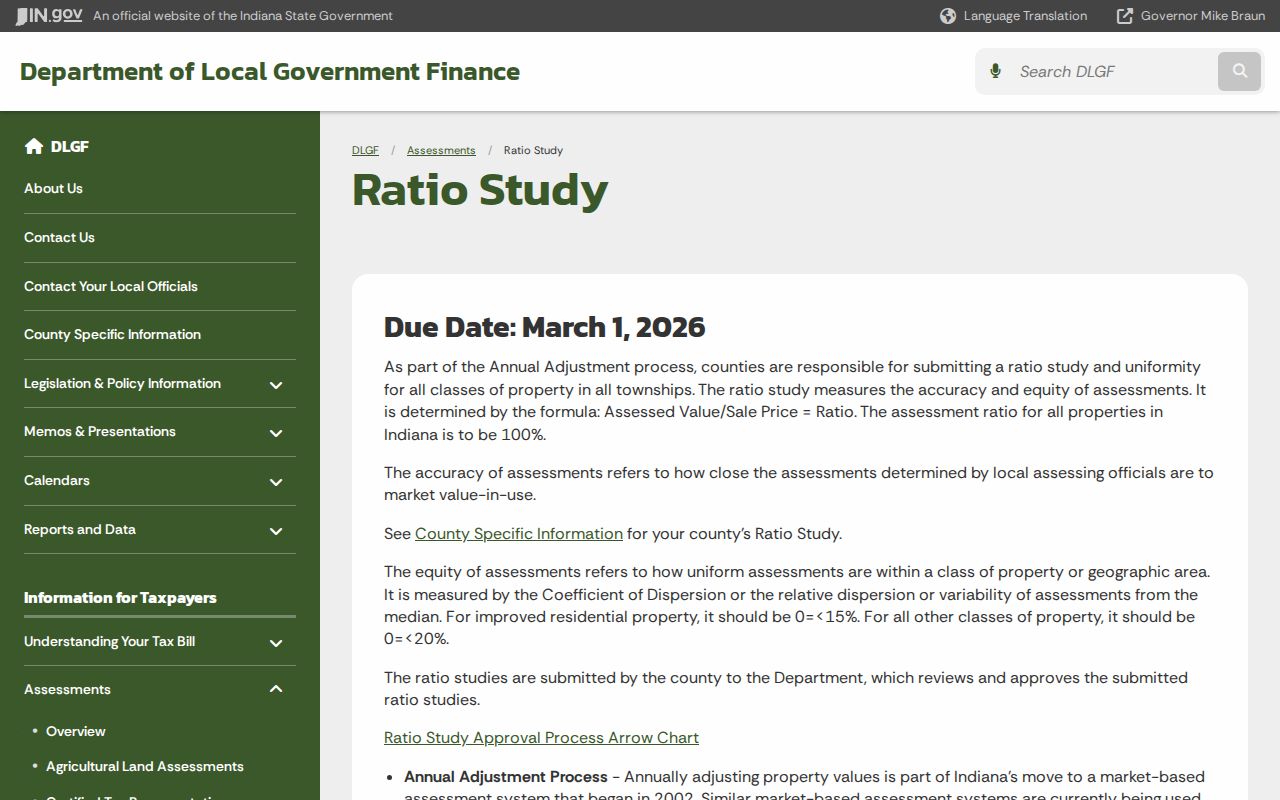
Use the ratio as group-level assessment evidence, not as a parcel appraisal.
Sale Price Is One Event
Brown County's Assessor keeps sales information from 2007 forward. Indiana's public sales-disclosure search covers disclosures filed after July 1, 2008. Dates, prices, parcels, and classification clues all appear.
Reported consideration may span multiple parcels. Family or estate terms, unusual financing, or an exempt transaction can explain an odd figure. State law also restricts phone numbers in sales-disclosure records. Compare the deed's legal description with the assessment parcel before crediting one price wholly to one card.
Note: A last-sale field is a historical transaction clue, not a live asking price or an estimate of current proceeds.
Brown Land and Improvement Splits
Total assessed value combines land and improvements. That split explains a lot. Two nearby parcels with similar acreage can carry different totals because one is vacant and the other holds a home, garage, finished space, or other assessable features recorded on the card.
The improvement figure is not a construction-cost estimate. It is one component of the mass-assessment record. Check the card's physical data. Wrong year built, square footage, stories, exterior, plumbing, or special features can distort the value comparison too.
Brown's 2026 Reassessment Cycle
Indiana is moving to a four-year cyclical reassessment. It starts July 1, 2026, and affects 2026 pay-2027 taxes. Under the DLGF schedule, roughly 25 percent of parcels in each jurisdiction get inspected annually. Inspectors confirm physical details like construction, garages, and pools. So a Brown County parcel sits under review once every cycle, not all at once. A property card may simply gain corrected facts as its turn arrives. That is normal. Timing matters here. Keep the date on anything you download. Lean on DLGF's plan-approval, inspection-status, and data-entry maps when you need to know where a parcel stands. Brown's current DLGF county page posts the 2026 ratio study as well. It also posts the approval letter, narrative, and land order.
Access Brown County Value Records
Several offices divide the work. WTH runs the parcel map, result, and property-card route. DLGF covers the statewide assessed-value search plus county reports, ratio studies, and sales-disclosure references. The Assessor takes questions in person, by phone, email, or mail about its card. The Auditor handles deductions rather than the assessment method itself. The Recorder supplies deed context when a transfer appears in the property records. Make any request specific. Bring the full county APN, the property address if one is assigned, the assessment year, and the exact field in dispute. Indiana APRA generally allows inspection during office hours. An agency must answer an oral request within 24 hours. A written one is due within seven calendar days. That clock is not a promise of instant production, though. Older or voluminous records can take longer.
Brown Property Value Limits
Keep a Brown County assessed value in perspective. It exists to support the property-tax system. It does not prove title, fix a boundary, or guarantee a sale price. It is no substitute for an appraisal. A fast-moving market can also shift between the assessment date and a later transaction. Read the card for what it is: the public assessment and its component facts. Turn to sale disclosures and deed records when you need to understand a specific transfer. An independent opinion may be tied to a purchase, an estate, financing, or another assignment. For that, hire a qualified appraiser and share the relevant effective date.
Value versus price. Brown County assessed value is used for taxation. It is not a promise of sale price and is not a property appraisal.