
Brown County Deed Types
The Brown County Recorder files every instrument that affects land. It may create, transfer, secure, release, or describe an interest. A deed records a conveyance from one party to another. Its type and wording control what moved. Promises, if any, ride along in the text. So treat the index label as a starting point. Read the actual image before concluding anything.
| Deed Type | What It Does | Common Use |
|---|---|---|
| Warranty deed | Conveys the stated interest with title covenants written in the instrument. | Ordinary arm's-length transfers. |
| Quitclaim deed | Transfers whatever interest the grantor holds without broad title promises. | Family, estate, or title-cleanup transfers. |
| Trustee or executor deed | Conveys through a named fiduciary acting under trust or estate authority. | Trust administration and probate-related sales. |
| Survivorship instrument | Documents an interest passing under joint ownership or a death-related filing. | Updating the recorded ownership trail. |
| Sheriff's or tax deed | Records a transfer tied to a court or delinquent-tax process. | Distressed-property transfers. |
A mortgage or lien is not a deed. Either one can secure debt without conveying ownership. Releases, assignments, rights-of-way, restrictive covenants, and plats also sit beside Brown County deed records in the same land-record index.
Brown County Recorder and Doxpop
The Brown County Recorder is the official custodian. The office sits at 201 Locust Lane, 1st Floor, in Nashville, with mail sent to PO Box 86. Call 812-988-5462 for search help and copy questions. Email works too, at recorder@browncounty-in.gov. For online research, the county sends users to Doxpop Recorder, which indexes Brown County parties, dates, instrument types, and land-description terms. A free search exposes index details. Previewing, saving, or printing an image may require an account or payment, and a paid portal image is not a certified county copy. The official Doxpop Recorder page displayed here is the county's online route into deed records.
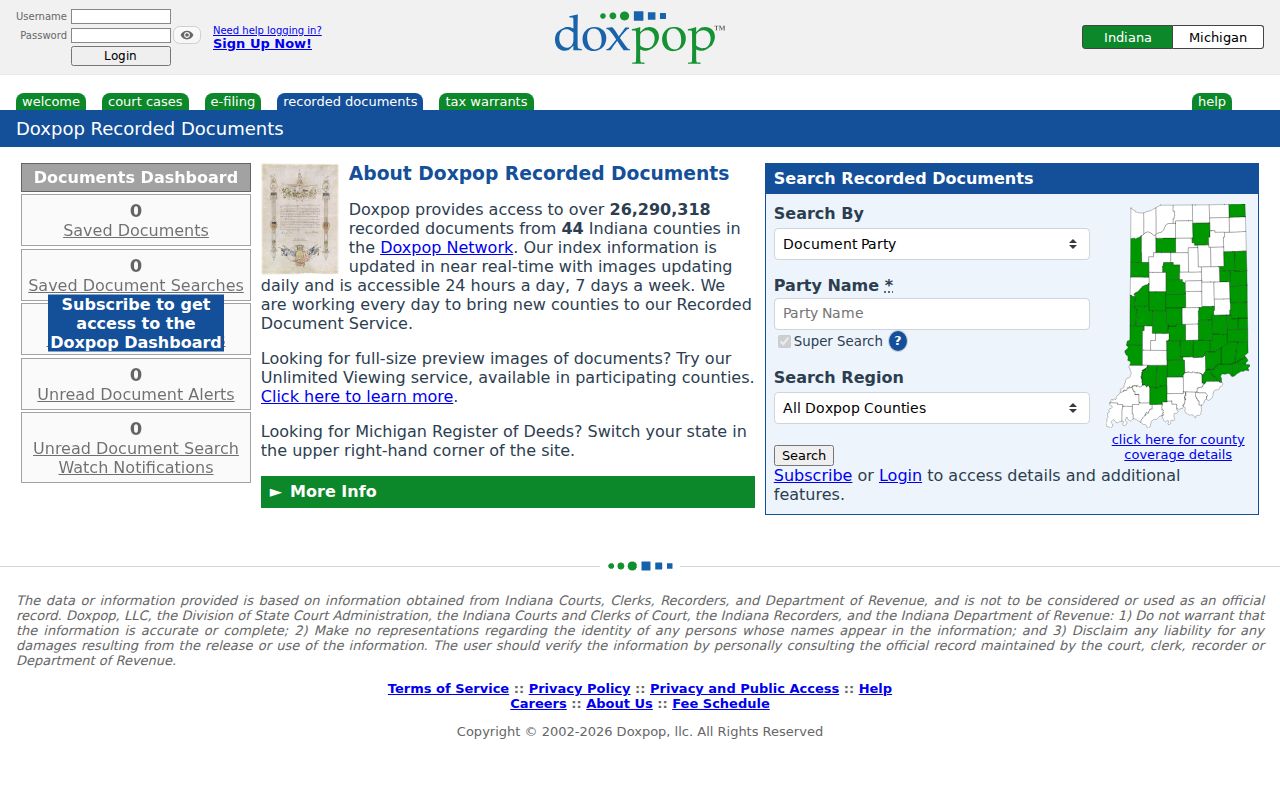
Use the portal for discovery, then call the Recorder.
Search Brown County Deed Fields
Doxpop separates party, date, type, and land fields. Platted and unplatted descriptions use different groups. Spelling and field choice matter, since a Brown County rural tract may have no lot or subdivision name.
| Index field | Format | Brown County use |
|---|---|---|
| Party name | Grantor or grantee text | Try surname, trust, estate, and entity variants. |
| Recorded date | From and to dates | Narrow results near a known sale or filing. |
| Document type | Optional filter | Separate deeds from mortgages, liens, releases, and plats. |
| Lot, block, subdivision | Platted fields | Match the addition name exactly as indexed. |
| Township, section, range | Unplatted fields | Find rural land described outside a recorded plat. |
| Full text or OCR | Optional text | Find words in supported images; faint and handwritten text may be missed. |
Doxpop's advanced-search explanation shows its platted and unplatted controls.
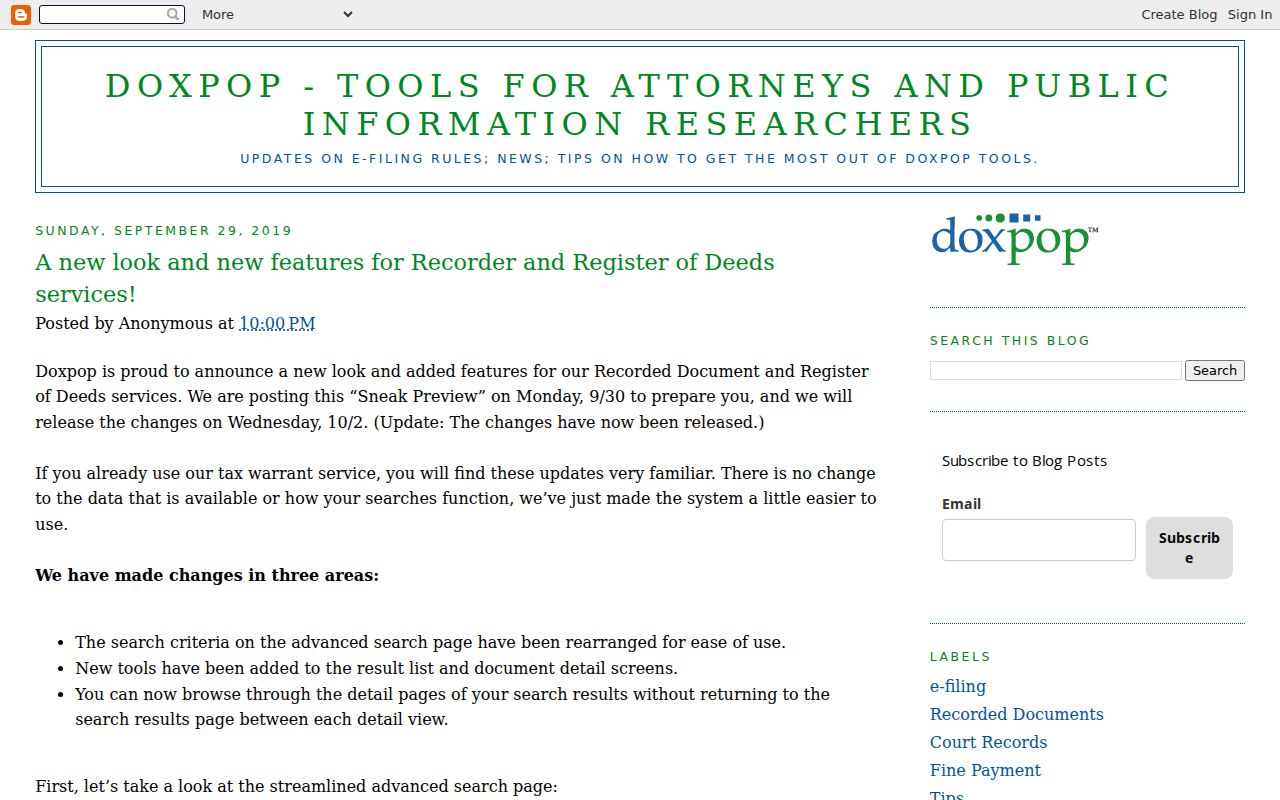
Those land groups are mutually exclusive. Pick an unplatted mode and the lot fields disappear. The platted and unplatted forms simply cannot be searched together. Note: OCR is a finding aid only and may skip handwritten, faint, or older deed language.
Brown Deeds Begin Online in 1988
Online coverage starts in July 1988. Doxpop's Brown County index data and scanned images begin at that point. The date is a portal boundary rather than the start of local ownership records, so a blank search for an older owner says little about whether the deed exists. The Doxpop county coverage list documents the start point.
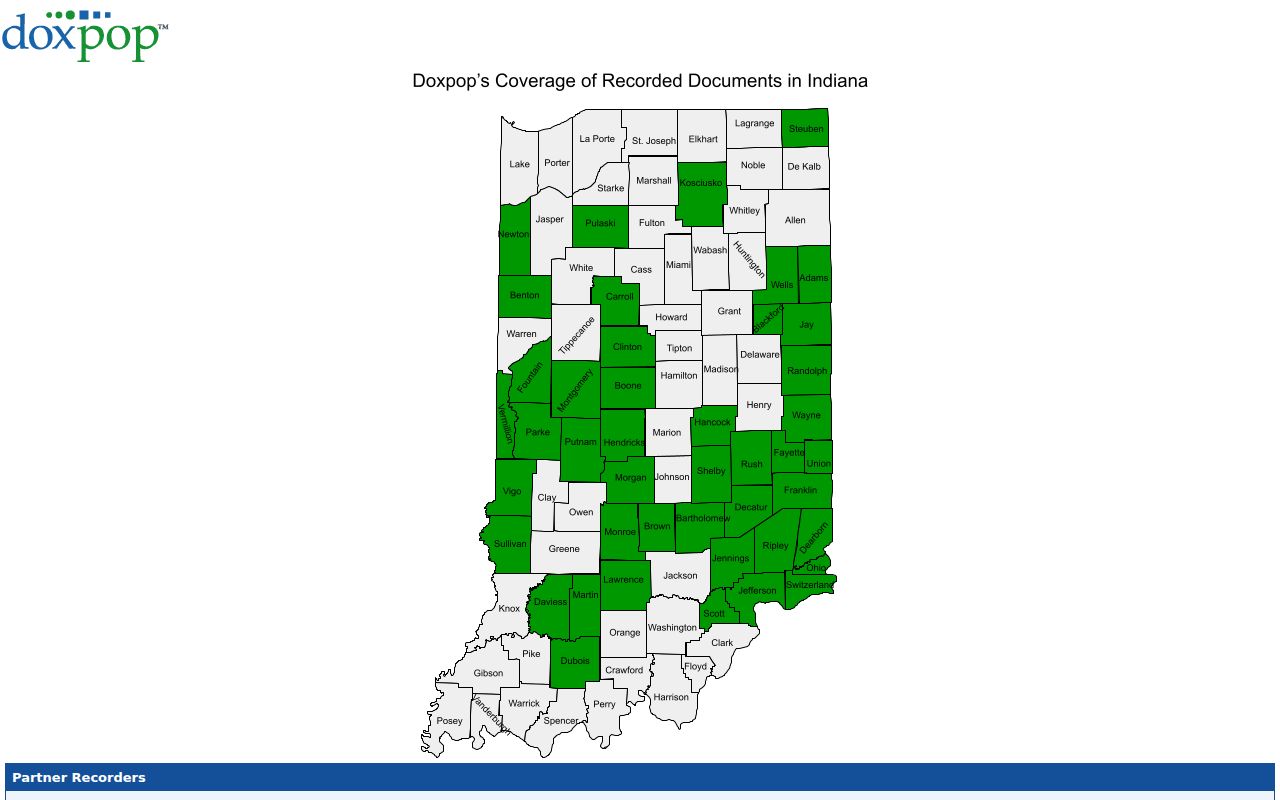
That listed date is a practical signal. It tells a researcher exactly when to switch from the web index to books, microfilm, library, or office access.
Brown County Grantor-Grantee Chain
A grantor gives the stated interest. A grantee receives it. Tracing Brown County deed records backward means starting with the newest conveyance and holding the legal description constant while the names change. Names alone can join unrelated parcels, especially with common surnames or trusts.
- Find the current owner's purchase deed with that owner shown as grantee.
- Read the grantor, recording date, document number, and full legal description.
- Search that grantor as an earlier grantee and confirm the same land description.
- Repeat until the chain reaches July 1988, then move to the older indexes and deed books.
- Grantor
- The party that transfers the stated interest.
- Grantee
- The party that receives the stated interest.
- Chain of title
- The linked sequence of conveyances affecting the same land.
- Book and page
- A reference to a bound or imaged record series.
- Instrument number
- A unique filing identifier assigned at recording.
Estate and court instruments interrupt the chain. Trustee, survivorship, and affidavit documents can do the same, so check probate or MyCase when the next owner appears without an ordinary purchase deed.
Deed Books After the 1873 Fire
A courthouse fire in November 1873 destroyed most Brown County records. That event makes coverage analysis part of any old chain. The Indiana State Library Brown County guide identifies original custodians and surviving research paths, while its microfilm finding aid lists deed and index series.
Deed books A-B span 1849-1878, and C-D span 1878-1924 in the finding aid. The L-1 through L-16 microfilm series includes deed books and grantor or grantee indexes extending through parts of 1907 or 1924. Search both name alphabets, including initials, former surnames, and corporate or trust names. Compare acreage, adjoining owners, road calls, and section data when a metes-and-bounds deed lacks a modern address.
Older Brown County deed records may be accessed through the Recorder, State Library, archives, or linked FamilySearch resources. Call ahead before assuming a particular book or scan is available at the Nashville counter.
Brown County Deed Fees
Brown County's fee schedule splits recording from copy charges. Recording runs $25. That covers a deed, UCC, or other instrument. A mortgage costs $55, and a mechanic's lien with one mail-out costs $25. Multiple-transaction documents are not accepted. These Brown County figures come from schedules effective in 2021, so confirm them before filing or mailing payment. Copy prices are simple. Pages at 11 by 17 inches or smaller run $1 each, larger sheets $5, and certification adds $5 per document. A 24 by 36 inch plat costs $4. The first cross-reference is included, with each additional one at $7, and Doxpop account and image prices stay separate from Recorder charges. Note: Ask the Recorder to confirm the current total, accepted payment, page count, and return-mail needs before ordering a deed copy.
Brown Deeds and Related Instruments
A full parcel trail in Brown County reaches past the conveyance deed itself. Search close recording dates for purchase-money mortgages, then follow the later assignments, modifications, releases, and satisfactions. Check the remaining instruments too: mechanic's liens, judgment liens, tax liens, easements, rights-of-way, covenants, land contracts, fixture filings, plats, replats, vacations, affidavits, and lis pendens all mark the property records that shape a parcel's history.
- Match each instrument to the legal description, not the party name alone.
- Follow a mortgage assignment through to a release or later court action.
- Read plats and separate easement instruments together.
- Use MyCase for public foreclosure, quiet-title, judgment, or probate proceedings.
- Check the Recorder for the deed or release that follows a final case event.
An old lien in the deed index may have been released under a different name or a later instrument number. The index simply shows the trail to inspect. It decides nothing about present enforceability or priority.
Property Watch in Brown County
Doxpop Property Watch sends free alerts built on party names and whatever legal-description indexing exists. Brown County hosts no separate fraud-alert portal of its own. Indiana recorders are not required to index every address or parcel number. So an alert cannot depend on those fields alone. The official FAQ warns that rural legal descriptions may narrow only to a section. That can trigger notices for neighboring parcels. Treat any alert as a prompt, not a verdict. Pull the actual filing, verify the land and the parties, and contact the Recorder. Useful notice is not proof of fraud, and it never replaces periodic deed review. The Property Watch enrollment page shows the alert route available for Brown County property records.
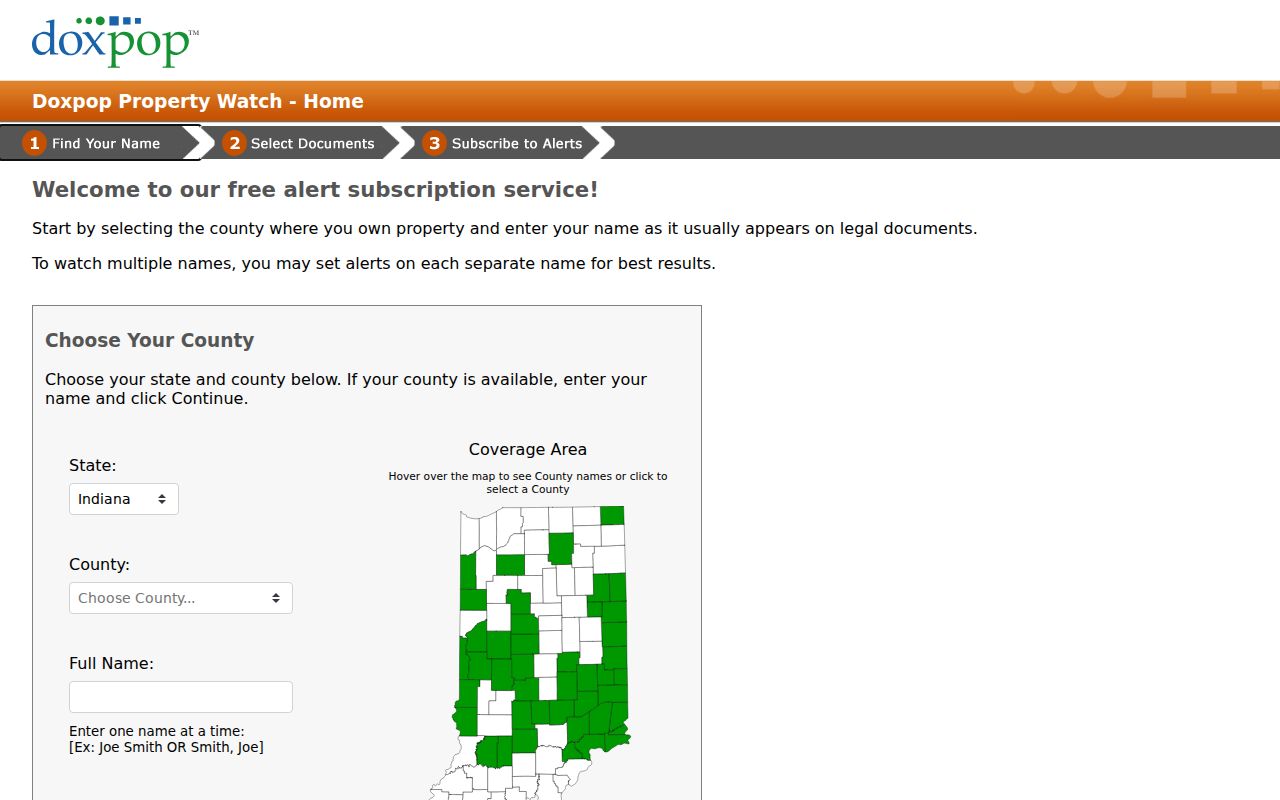
The broad matching is deliberate. Check every false positive against the recorded instrument itself before drawing conclusions.
Obtain a Brown County Deed Copy
Start with Doxpop to pull the instrument number, date, type, parties, and legal description. A portal image often works for preliminary research. An official copy takes a request to the Brown County Recorder by phone, email, mail, or at the Nashville counter. Say up front whether the copy must be certified. Include the full reference, parcel number, and any description you have.
Indiana's Access to Public Records Act, IC 5-14-3, backs inspection during regular business hours, subject to confidentiality rules and office procedures. Search and inspection are generally free. Copies may carry statutory or actual-cost charges. A written request should draw an agency response within seven calendar days, though production time depends on the records' age, volume, retrieval, and any redaction.
Recorded, not guaranteed. Brown County deed records show filed instruments, not a legal opinion on clear title or priority. Unrecorded interests and indexing gaps may exist.
A certified copy confirms the county's own copy of a filing. It does not certify that no other deed, lien, probate order, boundary problem, or off-record claim touches the land.