
Trace Brown County Former Owners
A backward chain is a transfer timeline. Add a row only after the legal description, lot, or parcel reference proves the instrument covers the same land. Names alone are too weak.
| Source | Years It Covers | Where Held | What It Shows |
|---|---|---|---|
| Newest deed transfer | July 1988 forward online | Doxpop and Recorder | Grantor to grantee, deed type, recording reference |
| Deed books A-B and C-D | 1849-1878 and 1878-1924 | State Library microfilm | Older conveyances by book and page |
| Numbered deed books 1-21 | 1873-1901 | Microfilm and county sources | Earlier owners and legal descriptions |
| Grantor and grantee indexes | 1873-1907, with alternate runs through 1900 | State Library finding aid | Alphabetic party route into deed books |
Start with Doxpop Recorder for any modern transfer. That portal carries the recent decades of recorded deeds. When the timeline reaches July 1988, move to indexed microfilm and deed books instead of treating an empty web result as the end of the line.
Brown's July 1988 Cutoff
Doxpop's county coverage list reports Brown County index data. It also lists scanned images beginning in July 1988. That month is the earliest online Recorder coverage. So a deed from the 1970s or the 1850s can exist even though the portal returns nothing. The portal simply returns nothing for it. The official Doxpop coverage page shows exactly where Brown County's online former-owner chain begins.
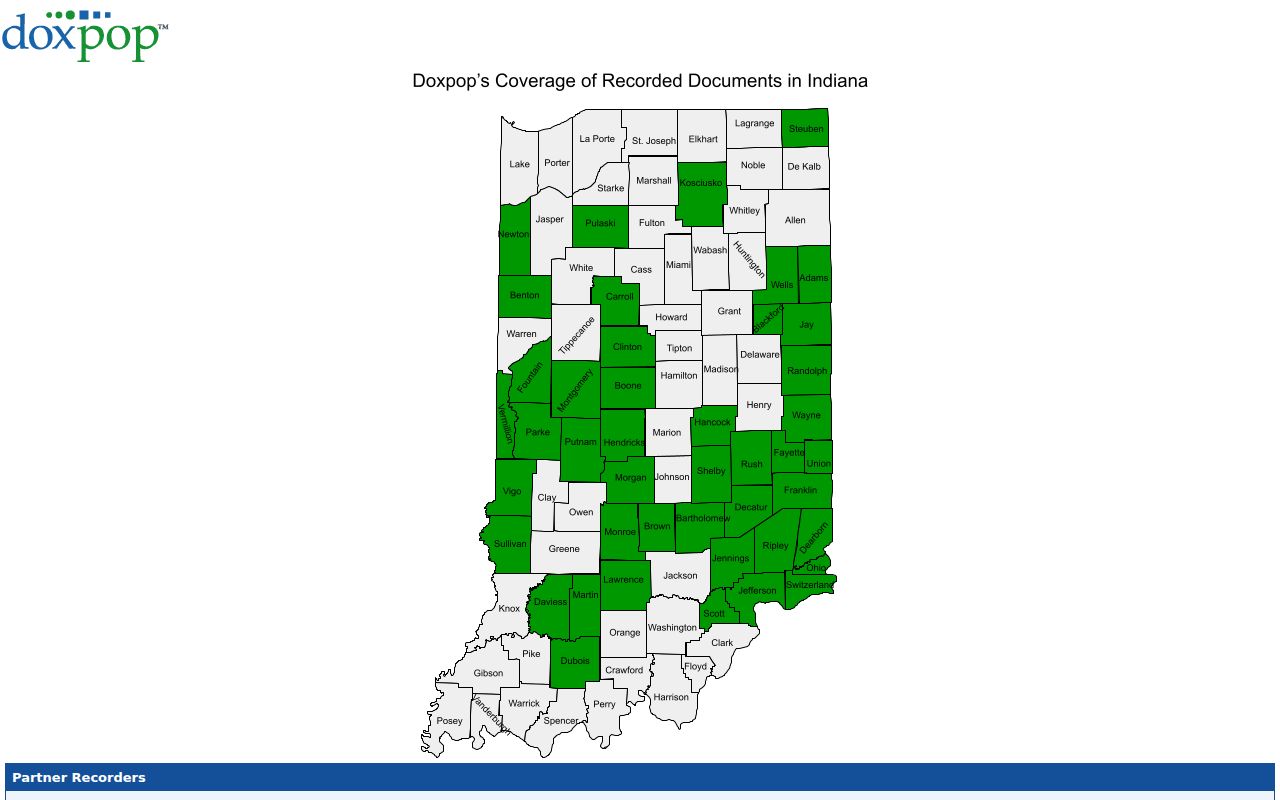
That listing backs up the date cutoff. The State Library finding aid then supplies the route to earlier volumes. Along the way, capture the recording date, instrument number, deed type, and indexed parties and their roles. Note the legal-description text too. Add the book, page, or image reference. Portal image access can depend on registration or payment. For a certified county copy, ask the Brown County Recorder. Do not treat a downloaded vendor image as certified.
Online boundary. Brown County's web deed chain begins in July 1988. Older owners live in books, microfilm, library holdings, and office records.
Brown's Nineteenth-Century Bridge
The Indiana State Library finding aid gives prior-owner research a genuine bridge. That bridge reaches into the nineteenth century. It identifies deed books A-B and C-D, numbered books, and separate grantor and grantee indexes. Use an index entry to reach a volume and page. Then read the deed description itself.
A grantor transferred an interest. A grantee received it. A chain of title links those instruments together for one piece of land. A reverse index checks the other party role. A quitclaim conveyed whatever interest the grantor held, while a warranty deed carries different assurances. The instrument's exact text, not its short type label, controls the meaning.
Walk Brown's Deed Chain Backward
Repeat one careful loop. The owner named today is only the starting clue, so each earlier grantor must be tied back to the same legal description.
- Find the latest purchase deed and copy the grantee, grantor, date, deed type, and legal description.
- Search that grantor as a grantee to locate how the prior owner had acquired the same tract.
- Compare lot, block, addition, section, township, range, and book/page before adding a row.
- Repeat. At July 1988, switch from Doxpop to the historic indexes and deed books.
- Grantor and grantee
- The transferring and receiving parties named in a deed.
- Chain of title
- The ordered sequence of instruments affecting the same land.
- Legal description
- The recorded land description that is more stable than an old street address.
The 1873 Brown Records Fire
Brown County's courthouse burned in 1873. The Indiana State Library says most records were destroyed except certain Clerk files. That loss can break an early former-owner trail. It also explains why absence matters here. Absence must be read as a coverage question, not proof of anything.
Brown County was created in 1836 from parts of Bartholomew, Jackson, and Monroe Counties. Surviving county books and later recitals do not always close the gap. Deed abstracts, predecessor-county material, plats, and State Library holdings may help. Never manufacture an owner to bridge a missing volume.
Brown Legal Descriptions Persist
Road names and rural addresses change. A legal description persists. Platted land is often searched by lot, block, and addition, while unplatted land uses section, township, range, and similar terms. Doxpop's search modes treat those two groups separately.
The County Surveyor keeps legal survey books, old grant books, section-corner records, and historic railroad, right-of-way, county-road, and miscellaneous survey maps. Scanning is still in progress, so call 812-988-5500 for access. A licensed surveyor is needed for any boundary opinion.
Estate Links in Brown Ownership
A death or probate can interrupt a plain buyer-seller pattern. Search name variants, estate terms, trustee wording, initials, and joint-owner forms. Common examples include ETAL, C/O, trust abbreviations, and JTW/RIGHTS OF.
Indiana MyCase and the Brown County Clerk can supply public probate or court context. Then return to the Recorder for a personal representative's deed, transfer-on-death deed, or affidavit. You can also look for another land instrument there. Court records explain the event; the recorded instrument anchors the prior-owner chain.
Brown Plats Test Prior Owners
A parcel split, consolidation, or replat can make an ownership chain appear to jump. Compare the acreage and land calls in each deed. Do not assume a repeated surname covers the whole present parcel. A later deed may combine several earlier tracts. An old owner may have conveyed only one part.
Brown County's subdivision process creates two useful records. Planning and Area Plan Commission files may hold a recent deed. They may also hold covenants, easements, restrictions, utility or septic material, and a surveyor-prepared plat. The approved plat is then filed with the Recorder outside Nashville jurisdiction. Search both the hearing file and the recorded land instrument. Place only a verified conveyance in the deed timeline.
For Nashville land, town development and zoning records can explain a replat or boundary action. Ownership stays county-held. The land description, deed reference, and plat name matter. They keep those sources tied to the correct tract. Cross-checking them protects the chain from false jumps.
Access Brown Former-Owner Records
The Brown County Recorder keeps the deed records that carry former-owner history. Visit the office at 201 Locust Lane, 1st Floor, Nashville. You can also call 812-988-5462, email recorder@browncounty-in.gov, or mail PO Box 86. State the party name and date range. Include the legal description, APN, and any known instrument or book and page reference. The more detail you give, the faster the search.
Older deed books reach further back through several routes. The State Library guide and microfilm both help. County office holdings, library or archive access, and FamilySearch help too. Ask each about in-person inspection, mail delivery, and current copy terms. Do that before you plan a trip. Indiana APRA generally permits inspection during regular office hours unless an exception applies.
Note: Record every name variant and failed year range. Do not mistake a missing index hit for proof.
How Far Brown Ownership Goes
Brown County previous owners can often be traced through modern deeds. The trail can also reach books from the mid-nineteenth century. No unbroken chain to 1836 is guaranteed. Fire loss, missing volumes, name changes, parcel splits, and replats can stop the work at any point. They can also branch it.
Recorded plats can settle a lot's history when the deed chain grows murky. County subdivision rules require approved plats outside Nashville jurisdiction to be filed with the Recorder. Planning hearing files may add surveys, easements, restrictions, and access material. Use both, but let the recorded land description remain the test of the chain.
Lawful use. Research Brown County former owners for estate work, property history, and title diligence. Never use the chain to track, harass, intimidate, or harm a living person.